
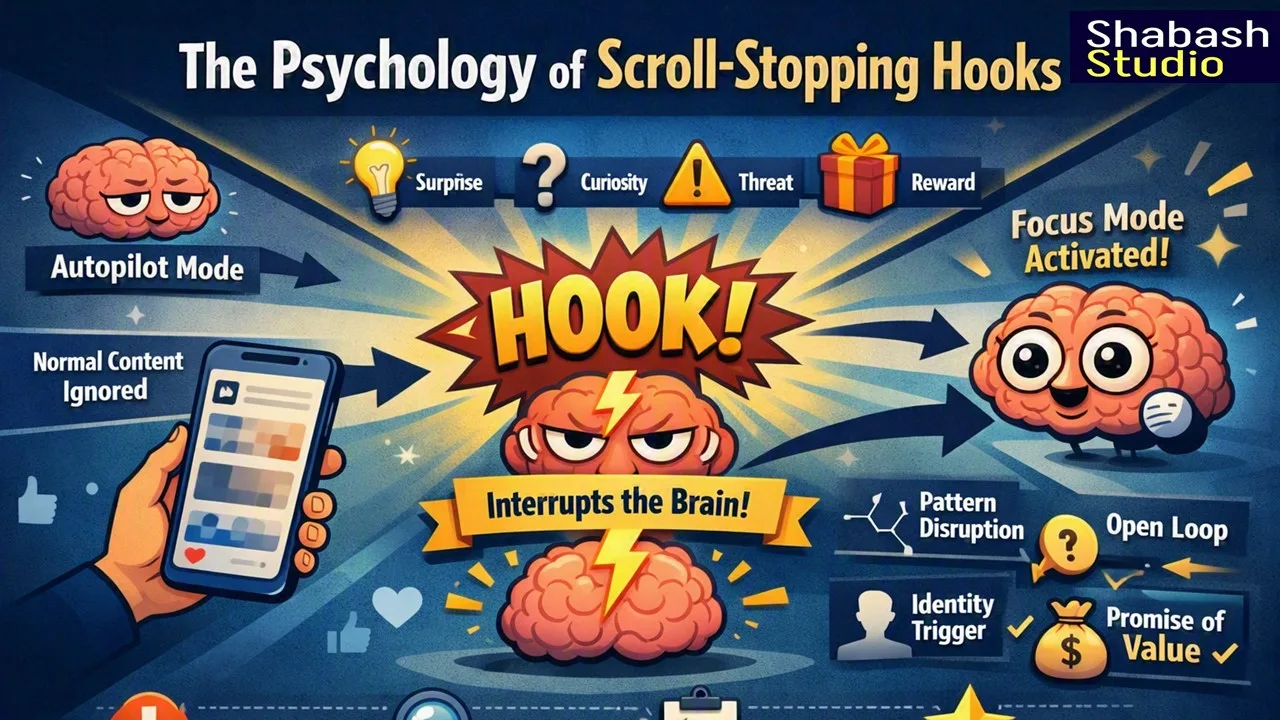
A scroll‑stopping hook works because it hijacks the brain’s automatic filtering system. Your audience is scrolling in a trance, and your scroll‑stopping hooks’ single job is to break that trance. The most effective scroll‑stopping hooks trigger curiosity, tension, or reward fast. By incorporating scroll‑stopping hooks, you ensure a higher engagement rate.
Why the brain ignores most content
The human brain is a ruthless editor. It filters out 99% of incoming information to conserve energy. When someone scrolls through Instagram, TikTok, or LinkedIn, their brain is in low‑effort mode, scanning for patterns, familiar shapes, and predictable content. Anything that looks “normal” gets discarded instantly.
Implementing scroll‑stopping hooks can significantly increase your content’s visibility and retention.
This is where your hook comes in. Its job is to disrupt the pattern.
The brain pays attention when it senses:
- Novelty — something unexpected
- Threat — something that feels urgent
- Reward — something that promises value
- Emotion — something that feels personal
A great hook activates at least one of these triggers.
In essence, scroll‑stopping hooks are vital for capturing attention in today’s fast-paced digital landscape.
🧠 The psychology behind interruption
Your hook must create a micro‑shock — a tiny jolt that forces the brain to switch from autopilot to focus mode. This is called an orienting response, the same mechanism that makes you turn your head when you hear a sudden noise.
Three psychological principles drive this response:
1. Pattern disruption
The brain loves patterns. Break one, and attention snaps to you.
Examples:
- “Everyone is lying to you about productivity.”
- “Stop doing this one thing — it’s killing your engagement.”
These statements violate expectations, forcing the brain to investigate.
2. Open loops
Humans hate unresolved information. When you create an open loop, the brain feels compelled to close it.
Examples:
- “I made one change that doubled my sales — but nobody talks about it.”
- “This is the mistake every beginner makes.”
The hook creates tension, and tension demands resolution.
3. Identity activation
People pay attention when something threatens, validates, or challenges their identity.
Examples:
When using scroll‑stopping hooks, ensure they align with your target audience’s interests.
- “If you’re still doing this, you’re not a real designer.”
- “Smart marketers already know this — do you?”
Identity is the strongest psychological lever in marketing.
🌟 Creating scroll‑stopping hooks that engage your audience
🔥 What makes a hook scroll‑stopping
A scroll‑stopping hook is not just clever. It’s biologically effective. It must:
- Interrupt the brain
- Create curiosity
- Promise value
- Build tension
- Feel emotionally charged
Here’s the formula:
Interruption + Curiosity + Tension + Reward = Scroll Stop
Let’s break it down.
🧩 Interruption
Crafting effective scroll‑stopping hooks is an art form that can elevate your content strategy.
This is the “brain slap.” You disrupt the pattern with something visually or linguistically unexpected.
Examples:
- “Stop scrolling.”
- “Read this before you post again.”
- “This will hurt your ego.”
Guided Links: interruption techniques, visual hooks
🧩 Curiosity
Curiosity is the fuel that keeps the reader engaged. It’s triggered by:
- Missing information
- Contradictions
- Secrets
- Surprises
Examples:
- “Nobody told you this — but it’s the real reason your content flops.”
- “I tested something weird, and the results shocked me.”
Guided Links: curiosity triggers, content psychology
🧩 Tension
Tension is the emotional pull. It’s the feeling of “I need to know.”
Utilizing strong scroll‑stopping hooks can lead to a more engaged audience.
Examples:
- “This one mistake is costing you thousands.”
- “You’re doing everything right — except the thing that matters.”
Guided Links: emotional tension, copywriting tension
🧩 Reward
The brain needs to believe the payoff is worth the attention.
Examples:
- “Here’s the 10‑second fix.”
- “This trick will save you hours.”
- “Use this to triple your reach.”
📱 Why hooks matter more than ever
On platforms like TikTok, Instagram Reels, and YouTube Shorts, you have 0.8 seconds to capture attention. That’s less than the blink of an eye.
Remember, the goal of scroll‑stopping hooks is to pique curiosity and draw in your audience.
Your content competes with:
- dopamine‑optimized algorithms
- endless entertainment
- creators using advanced psychological tactics
- users who are half‑distracted
A powerful hook is your only chance to break through.
🎯 Types of scroll‑stopping hooks
🔑 Mastering scroll‑stopping hooks for better engagement
Below is a list of hook types — each starting with a Guided Link — that leverage different psychological triggers.
Effective scroll‑stopping hooks can be used across various platforms to improve engagement.
- Shock hooks — trigger surprise or disbelief
- Contrarian hooks — challenge common beliefsExperiment with different types of scroll‑stopping hooks to find what resonates best with your audience.
- Fear hooks — highlight risks or mistakes
- Identity hooks — challenge or validate identity
- Curiosity hooks — create open loops
- Value hooks — promise immediate benefit
- Story hooks — start with a compelling moment
- Data hooks — use surprising statistics
- Command hooks — direct the reader with authority
🧨 The secret: hooks work because they interrupt the brain
The effectiveness of your content relies on how well you implement scroll‑stopping hooks.
Your hook’s job is not to educate, explain, or entertain. Its job is to interrupt the brain.
Once you understand this, your content becomes dramatically more effective.
Here’s the psychological sequence:
- Interruption — brain snaps to attention
- Orientation — brain evaluates importance
- Curiosity — brain seeks missing information
- Engagement — brain commits to reading
- Reward — brain feels satisfied
If your hook fails at step 1, nothing else matters.
🚀 How to craft hooks that stop the scroll
Ultimately, mastering scroll‑stopping hooks will set your content apart in a crowded marketplace.
Here’s a practical framework you can use immediately:
1. Start with a disruption
Remember that integrating scroll‑stopping hooks should feel natural and not forced.
Say something unexpected, bold, or emotionally charged.
2. Add a curiosity gap
Hint at information without revealing it.
3. Build tension
Make the reader feel like they must know the answer.
4. Promise a reward
Show that reading further will be worth it.
🔚 Final thought
Incorporating scroll‑stopping hooks strategically can enhance your content’s effectiveness.
A scroll‑stopping hook is not magic — it’s psychology. It works because it interrupts the brain, triggers curiosity, and promises reward.
Master this, and your content will never be ignored again.
To truly harness the power of scroll‑stopping hooks, practice makes perfect.




Leave a Reply