
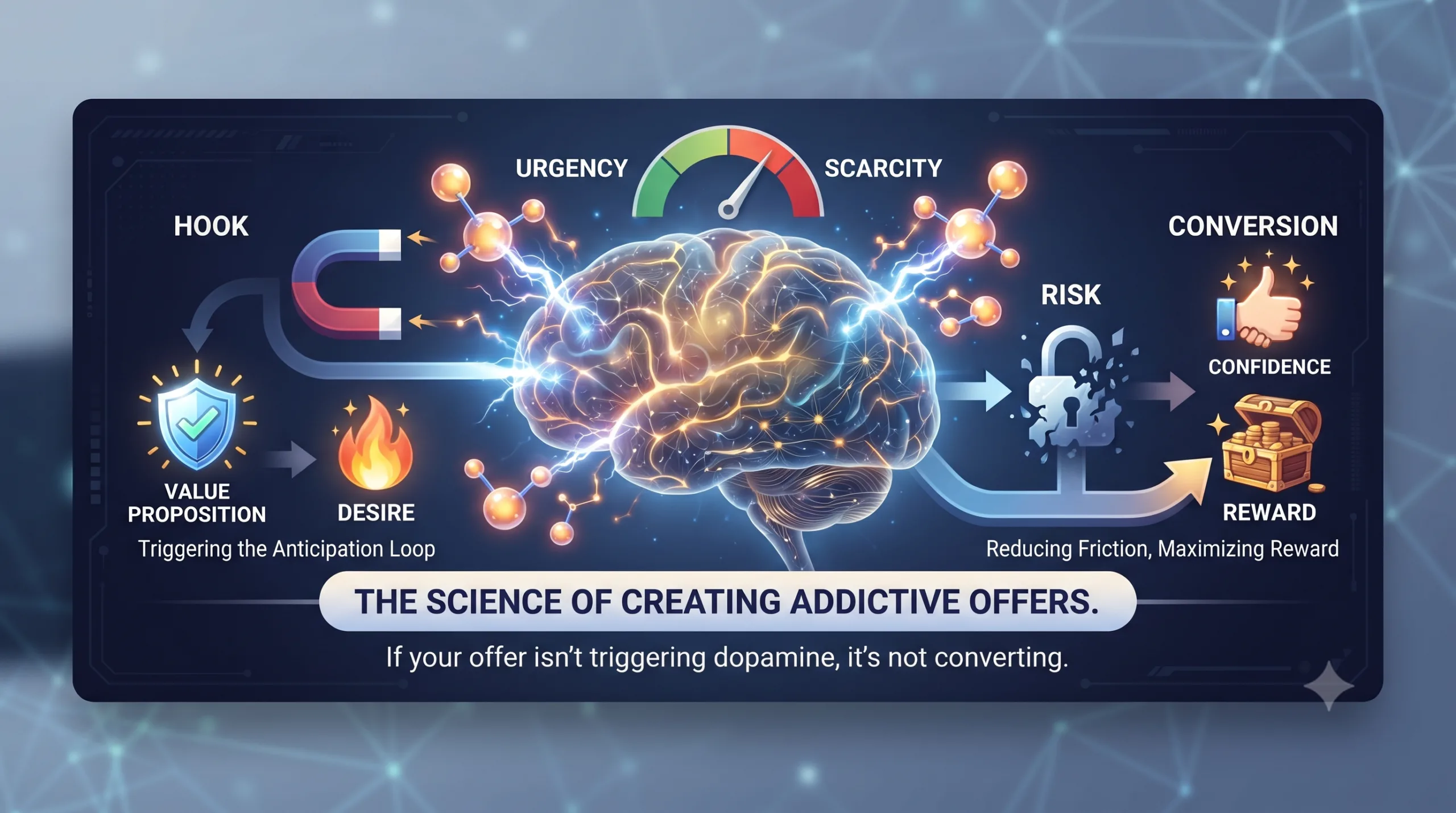
In the digital marketplace your ability to capture attention is the currency of success. Every scroll is a split second decision made by the brain. If your message fails to spark interest immediately it vanishes into the noise of the infinite feed. You might have the best product or the most revolutionary service but if your offer fails to trigger a chemical reaction in the mind of your prospect you will struggle to drive sales. The secret lies in understanding how we are wired. If your offer is not triggering dopamine it is simply not converting. This is where The Psychology of Persuasion comes into play. Understanding The Psychology of Persuasion and the dopamine loop becomes essential for marketers.
Understanding the Dopamine Loop
Dopamine is often misunderstood as the molecule of pleasure. In reality it is the molecule of desire and anticipation. It is the chemical that drives the brain to seek rewards. When you encounter a potential gain your brain releases dopamine to motivate you to take action. This is the foundation of an addictive offer.
By applying The Psychology of Persuasion effectively, marketers can enhance their ability to create compelling offers that resonate with consumers.
Incorporating elements from The Psychology of Persuasion can elevate your marketing strategies significantly.
Utilizing The Psychology of Persuasion allows you to structure your offers in a way that they resonate with the innate desires of your audience.
An offer that converts acts as a promise of a future reward. When a prospect reads your headline or sees your pitch their brain begins to calculate the potential benefit. If that benefit feels tangible urgent and superior to their current state a dopamine spike occurs. This spike creates an internal tension that the brain wants to resolve. The resolution is the conversion.
Understanding The Psychology of Persuasion can transform the way you craft your offers, making them more appealing and effective.
By mastering The Psychology of Persuasion, you can unlock the full potential of your marketing efforts.
The Elements of an Irresistible Offer
To create an offer that feels like a necessity rather than an option you must appeal to specific psychological triggers. These are not gimmicks. They are fundamental aspects of human behavior that have existed for centuries.
The Psychology of Persuasion is not just a concept; it’s a practical tool for driving conversions and creating impactful messages.
-
Radical Value Density: Your offer must clearly outline how the life of the customer improves after the purchase. People do not buy products. They buy better versions of themselves.
-
The Power of Contrast: The human brain evaluates information in relation to something else. By showing the high cost of inaction or the low relative cost of your solution you create a mental shift that makes your offer look like a bargain.
-
Urgency and Scarcity: These are the primary accelerators for the dopamine loop. When a reward feels limited or fleeting the brain shifts into a reactive state to avoid missing out.
Structuring Offers for Maximum Conversion
Applying The Psychology of Persuasion can provide insights into consumer behavior that are invaluable.
The way you package your offer determines whether it is perceived as a commodity or a premium solution. Commodity offers compete on price. Premium offers compete on transformation.
Eliminate Risk to Lower Friction
One of the greatest enemies of conversion is perceived risk. Even if your offer is spectacular the fear of regret will stop the dopamine flow. You must neutralize this fear. A strong guarantee or a clear pathway to success removes the mental barriers that prevent a buyer from committing. When you remove risk you lower the threshold for action and allow the natural desire for the reward to take over.
Simplify the Decision Path
The brain hates complexity. If your offer requires too much cognitive effort to understand the dopamine loop breaks. Your messaging should be punchy and direct. Avoid jargon that confuses the reader. Use clear and benefit driven language that paints a vivid picture of the desired outcome. If a customer has to think too hard they will likely close the tab.
Designing the Perfect Hook
Each element of your offer should reflect The Psychology of Persuasion to maximize engagement.
The opening of your offer is the most critical component. This is the moment where you either earn the right to be heard or you are discarded. An addictive hook taps into a specific pain point or a deep seated desire.
For example consider the difference between saying we offer consulting services and saying we help you add fifty thousand dollars to your revenue in thirty days without increasing your ad spend. The second option provides a clear and measurable reward that triggers an immediate neurological response.
Ultimately, The Psychology of Persuasion allows you to stand out in a saturated market.
Keywords for SEO Success
Understanding and applying The Psychology of Persuasion can lead to better customer connections.
To ensure your message reaches your target audience you should integrate strategic search terms throughout your content. By focusing on terms like conversion optimization, consumer psychology, digital marketing strategy, and persuasive copywriting, you align your content with the questions your prospects are asking.
-
Conversion Optimization: Focus on how small changes lead to big results.
-
Consumer Psychology: Explain the “why” behind the “buy.”
-
Persuasive Copywriting: Teach readers how to write words that move people.
The Ethical Imperative
It is essential to note that the science of influence carries a significant responsibility. Understanding how to trigger dopamine and drive action is a powerful tool. When you use this knowledge to provide genuine value you create a cycle of trust and loyalty. When you use it to mislead or exaggerate you damage your brand and your integrity.
The most successful businesses are those that align their marketing with their reality. If you promise a transformation ensure your product delivers it. The strongest form of marketing is a result that exceeds the initial promise. This builds a secondary loop where your customers become your advocates which leads to even more conversions over the long term.
Executing Your New Strategy
By continuously learning about The Psychology of Persuasion, you position yourself as a thought leader in your field.
To begin applying these concepts look at your current offers through a new lens. Ask yourself if your message truly highlights the transformation. Does it create a sense of urgency? Does it make the next step feel easy and rewarding?
Leveraging The Psychology of Persuasion in your strategy can create a powerful narrative.
Quick Audit Checklist
-
Does my headline stop the scroll?
-
Is the primary benefit stated in the first sentence?
-
Have I clearly defined the pain point I am solving?
-
Is the offer framed as an urgent necessity?
-
Have I removed all possible reasons for hesitation?
Without understanding The Psychology of Persuasion, companies risk falling short of their potential.
Conclusion
The market is crowded but the principles of human psychology remain constant. By focusing on the biological triggers of desire and anticipation you move away from desperate sales tactics and toward a sophisticated strategy of attraction. When you craft offers that speak directly to the brain of your prospect you stop competing for attention and start commanding it.
In conclusion, The Psychology of Persuasion is vital for marketers aiming to create irresistible offers.
Mastering the science of conversion is a continuous process of testing and refinement. Start by identifying the biggest desire your customers have and build your entire offer around fulfilling that dream. Keep your messaging clear keep your value high and keep your focus on the transformation you provide. When you align your business with the way people think and feel you create more than just an offer. You create a movement.
Remember, mastering The Psychology of Persuasion can be the difference between a good offer and a great one.




Leave a Reply