
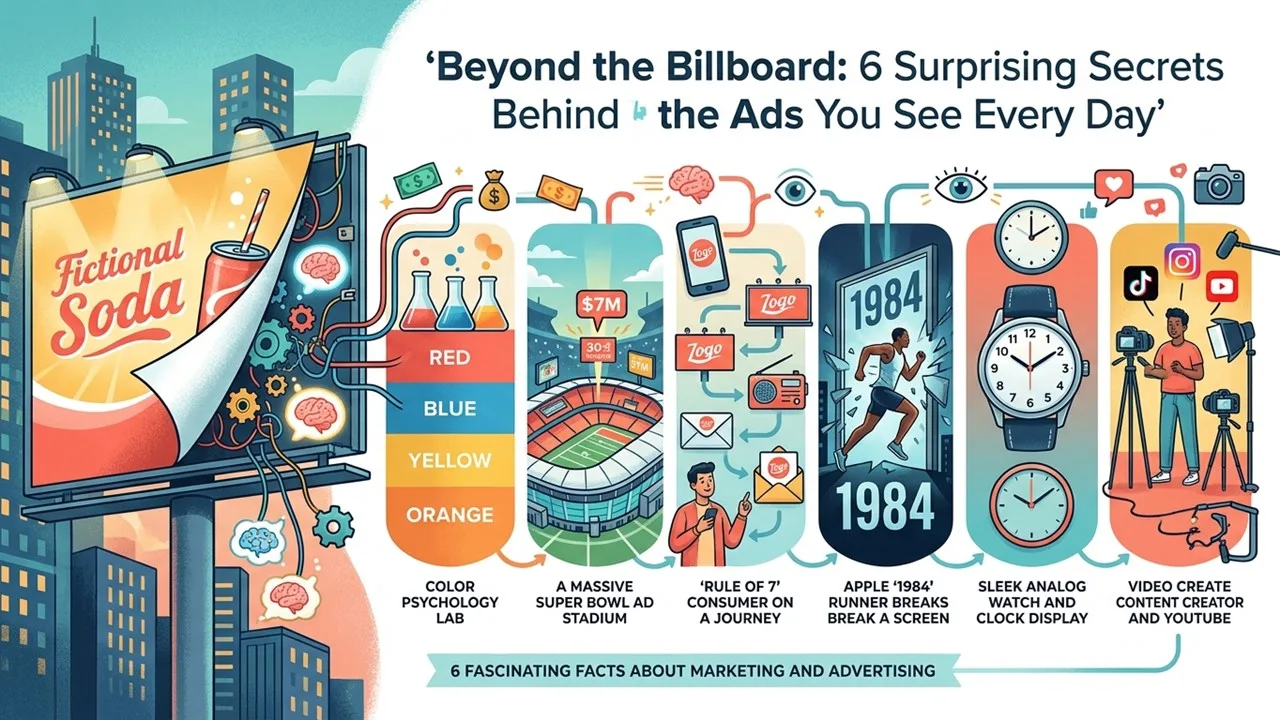
Marketing and advertising shape almost every choice we make daily, often without us even realizing it. Beyond catchy slogans and flashy billboards lies a fascinating world driven by human psychology, massive data analysis, and subtle sensory triggers. Here are six mind-bending facts about the Psychology of Advertising that reveal how brands capture our attention and influence our buying decisions. Understanding the Psychology of Advertising helps us become more aware consumers.
Understanding the Psychology of Advertising
1. Color Influences Up to 90% of First Impressions
When you look at a brand’s logo or packaging, your brain processes its color before reading any text. Research in color psychology shows that snap judgments about products are largely influenced by color, accounting for between 62% and 90% of the initial assessment.
Brands carefully choose colors to evoke specific emotional states:
-
Red creates urgency, stimulates appetite, and increases heart rate (think Coca-Cola, Target, and McDonald’s).
-
Blue builds trust, security, and dependability (preferred by banks, tech giants, and healthcare companies).
-
Yellow and Orange spark enthusiasm, optimism, and playfulness.
2. Super Bowl Ads Cost Over $7 Million for 30 Seconds
The Super Bowl remains the undisputed king of live television advertising. In recent years, a single 30-second commercial slot during the big game has commanded prices exceeding $7 million.
Why pay roughly $233,000 per second?
-
Massive Reach: It is one of the few global television events where over 100 million people watch live at the same time.The Psychology of Advertising plays a crucial role in why we choose certain brands over others. When companies leverage this knowledge, they can create marketing messages that resonate deeply with their target audience.
-
Cultural Relevancy: Super Bowl ads are treated as entertainment in their own right, generating millions of organic social media views, news headlines, and word of mouth chatter for weeks following the event.
3. The “Rule of 7” Is Still the Gold Standard
Originally developed in the 1930s by the movie industry, the Rule of 7 states that a potential customer needs to see or hear a marketing message at least seven times before they take action or make a purchase decision.
In today’s digital era, where consumers are bombarded with thousands of ads daily across social feeds, search engines, emails, and podcasts, repetition is more crucial than ever. Modern digital retargeting ads, email marketing sequences, and brand sponsorship deals are all designed around this principle to keep a brand top of mind until the consumer is ready to buy.
This principle is rooted in the Psychology of Advertising, where understanding how consumers think and feel can lead to more effective communication.
4. Apple’s “1984” Ad Aired Only Once on TV
Considered one of the greatest television commercials of all time, Apple’s famous “1984” ad, directed by Ridley Scott to introduce the Macintosh computer, officially aired on broadcast television only once.
The impact of Apple’s ad demonstrates the profound influence that the Psychology of Advertising can have on brand recognition and consumer behavior.
The 60-second spot aired during the third quarter of Super Bowl XVIII in January 1984. Despite running just a single time on air, it captured national media attention, was replayed endlessly on news broadcasts, and generated millions of dollars in free publicity, revolutionizing how companies launch new products.
5. Clocks in Advertisements Almost Always Show 10:10
If you look closely at print ads, commercials, or online listings for watches and clocks, you will notice that the hands are almost universally set to 10:10.
This choice reflects a deep understanding of the Psychology of Advertising, where visual appeal can significantly affect consumer perception.
This isn’t an accident. It is a deliberate visual choice driven by three key factors:
-
Symmetry: The hands form a clean, visually appealing “V” shape that frames the brand’s logo, which is typically located just below the 12 o’clock marker.
-
Positive Emotion: The angle resembles a subtle smiley face, creating an unconscious feeling of joy and warmth.Such strategies highlight the importance of the Psychology of Advertising in effectively conveying brand messages to consumers.
-
Visibility: Setting the hands at 10:10 ensures that date windows and secondary dials remain entirely unobscured.
6. Video Marketing Is Now the Primary Driver of Sales
Static imagery and text ads are increasingly giving way to dynamic video content. Social algorithms across TikTok, Instagram, and YouTube heavily favor video formats over traditional image posts.
Consumers overwhelmingly prefer video when researching products because it provides immediate proof of quality, demonstrates functionality, and builds authentic human connection. Marketers who integrate short-form and long-form video into their strategies consistently see higher engagement rates, improved brand recall, and higher conversion rates than those relying solely on static media.
Understanding the Psychology of Advertising allows marketers to create content that resonates and engages, leading to higher sales.
Marketing and advertising are far more than creative design. They combine behavioral psychology, strategic timing, and visual science. Understanding these mechanics helps businesses craft more effective campaigns and gives consumers a clearer view of how their purchasing decisions are shaped everyday. Ultimately, the Psychology of Advertising is fundamental in shaping modern marketing strategies, ensuring businesses connect meaningfully with their audience.








Leave a Reply