
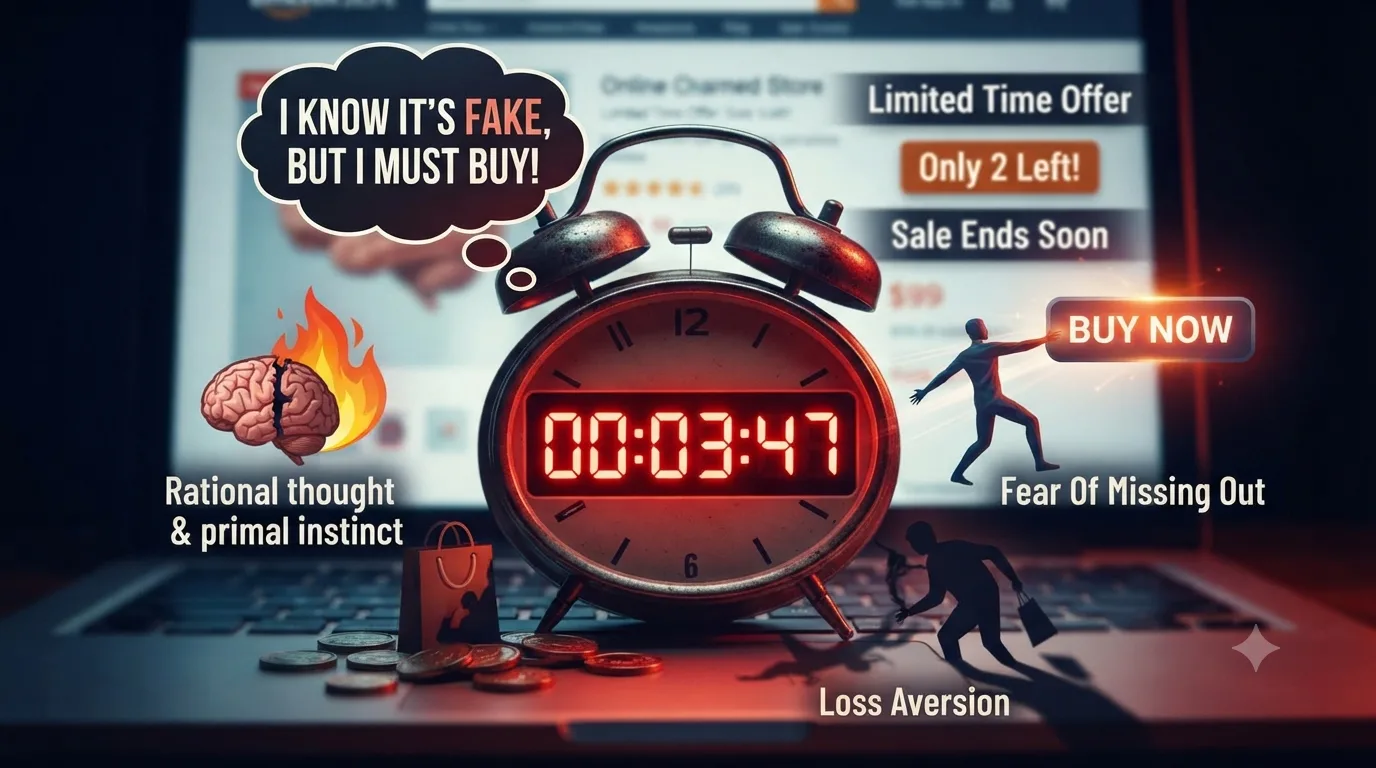
We have all been there scrolling through a website when a bright red banner flashes across the screen. It shouts that a sale ends in exactly ten minutes. You know the timer is a looped script that resets every time you refresh your browser. You understand that the store will likely host the exact same promotion next week. Yet you feel a strange prickle of anxiety in your chest. You find yourself adding items to your cart just in case.
This is the fascinating paradox of modern consumer behavior. Even when customers recognize that urgency is artificial they still act on it. Why does this tactic remain so effective despite our collective digital literacy? The answer lies deep within the human brain where primal instincts often override logical reasoning, often driven by the notion of Fake Urgency.
The Evolutionary Root Of Scarcity
To understand why fake urgency works we must look back at our ancestors. For most of human history resources like food and shelter were genuinely scarce. If a tribe found a grove of ripe fruit they had to gather it immediately before competitors or animals took it. Delaying action was not a matter of missing a deal it was a matter of survival.
This evolutionary wiring has not vanished in the age of ecommerce. Our brains are hardwired to value things that are limited in time or quantity. This is known as the scarcity principle. When we see a countdown clock our amygdala interprets that signal as a threat to our access to a resource. Even if the logical part of the brain knows the scarcity is manufactured the emotional response remains the same. The urge to secure the item before it disappears is an ancient impulse that is incredibly difficult to silence.
This is why the concept of Fake Urgency remains an essential tool for marketers aiming to influence purchasing decisions.
The Role Of Loss Aversion
Psychologist Daniel Kahneman famously demonstrated that humans feel the pain of loss roughly twice as intensely as the pleasure of gain. This phenomenon called loss aversion is a powerful driver of consumer behavior.
When an online store displays a message saying only two items are left in stock they are not just promoting a product they are triggering the fear of losing out. When a countdown timer ticks down it frames the situation as a loss of opportunity. If you do not buy now you lose the chance to save money or gain the benefit of the product. The discomfort of potential loss is often more motivating than the prospect of a future reward. We do not just buy to gain; we buy to avoid the regret of missing out.
Decision Paralysis And The Power Of Constraints
In our current digital landscape we are paralyzed by infinite choice. When a shopper visits a store with thousands of products they often experience choice overload. They browse for hours only to abandon their cart without buying anything.
Fake Urgency is a concept that needs careful consideration and ethical implementation in marketing.
Artificial urgency acts as a cognitive constraint that breaks this cycle. It forces a decision by introducing a deadline. By creating a temporary focal point the marketer helps the customer overcome inertia. The urgency effectively says stop searching and start deciding. Many consumers subconsciously welcome this pressure because it simplifies their mental load. They would rather make a slightly impulsive decision than endure the exhaustion of endless comparison shopping.
The Social Proof Factor
Urgency is rarely presented in isolation. Often it is paired with social proof markers such as messages stating that fifty other people are looking at this item or that five units sold in the last hour. This combination creates a powerful psychological feedback loop.
People are often drawn to promotions that incorporate Fake Urgency as a psychological trigger.
When we see that others are acting quickly our sense of social validation kicks in. We assume that if others are racing to buy something it must be valuable. The urgency creates a sense of momentum. It suggests that the window of opportunity is closing because of high demand rather than just a mechanical timer. This makes the artificial urgency feel more authentic. It transforms the act of shopping into a communal race where we do not want to be left behind.
Cognitive Fluency And The Path Of Least Resistance
By leveraging Fake Urgency, businesses can create a sense of urgency that prompts immediate action.
The human brain is an efficiency machine. We prefer to save energy whenever possible. This is why we often rely on heuristics which are mental shortcuts that allow us to make quick decisions.
Urgency cues are highly effective heuristics. They provide a simple rule for action. If the timer is counting down then now is the time to buy. If the stock is low then you should purchase immediately. These cues provide a clear path of action that does not require deep analytical thought. Because the brain prefers the path of least resistance it often chooses to follow the heuristic rather than questioning the validity of the urgency. It is simply easier to click buy than it is to investigate the marketing strategy behind the countdown.
The Ethical Balance In Modern Marketing
Some critics argue that artificial urgency is deceptive. They claim it erodes trust between brands and consumers. While there is truth to this it is important to distinguish between helpful nudges and outright manipulation.
It’s crucial to recognize the line between effective marketing and the misuse of Fake Urgency.
The most successful brands use urgency as a tool to facilitate the shopping process rather than to deceive. For example a time limited offer on an seasonal product is a genuine reflection of reality. A stock alert for a trending item is a helpful service to the customer. The issue arises when brands use aggressive timers that reset every time a user visits the site. This creates a negative feedback loop that eventually hurts the brand image.
Modern consumers are savvy. If they realize a brand is using blatantly false tactics they will eventually tune them out. The key to sustainable marketing is to use urgency in a way that respects the customer. Genuine scarcity is always more powerful than fake scarcity. When urgency is rooted in actual limited supply or specific event dates it builds trust instead of breaking it.
Creating a sense of urgency with Fake Urgency can lead to higher sales if done responsibly.
How To Use Urgency Ethically
If you want to drive conversions without alienating your audience consider these strategies:
-
Be Transparent: If an item is truly low in stock tell the customer exactly how many are left.
-
Focus On Benefits: Frame your urgency around the benefit the customer will receive rather than just the pressure to buy.
-
Use Real Deadlines: Align your sales with actual events like holidays or season changes.
-
Provide Context: Explain why the offer is ending so the urgency feels grounded in logic.
Using techniques to introduce Fake Urgency must be subtle yet effective to maintain consumer trust.
By aligning your tactics with genuine customer needs you can create a sense of momentum that feels helpful rather than manipulative.
Final Thoughts On The Psychology Of The Buy
The psychology behind urgency is a testament to how deeply our ancient instincts influence our digital lives. We are not just rational computers processing data points. We are emotional beings driven by the fear of loss the desire for social inclusion and the need for simplified choices.
Ultimately, Fake Urgency illustrates the power of psychological triggers in consumer behavior.
Fake urgency works because it speaks to these primal parts of our nature. It provides a nudge that we often do not realize we need. While it is important to maintain ethical standards the reality is that the countdown timer is here to stay. It is a powerful psychological tool that reflects the complex and often irrational way we interact with the world around us. Understanding this dynamic does not make us immune to it but it does help us become more conscious consumers in a marketplace that is designed to capture our attention at every turn.






Leave a Reply