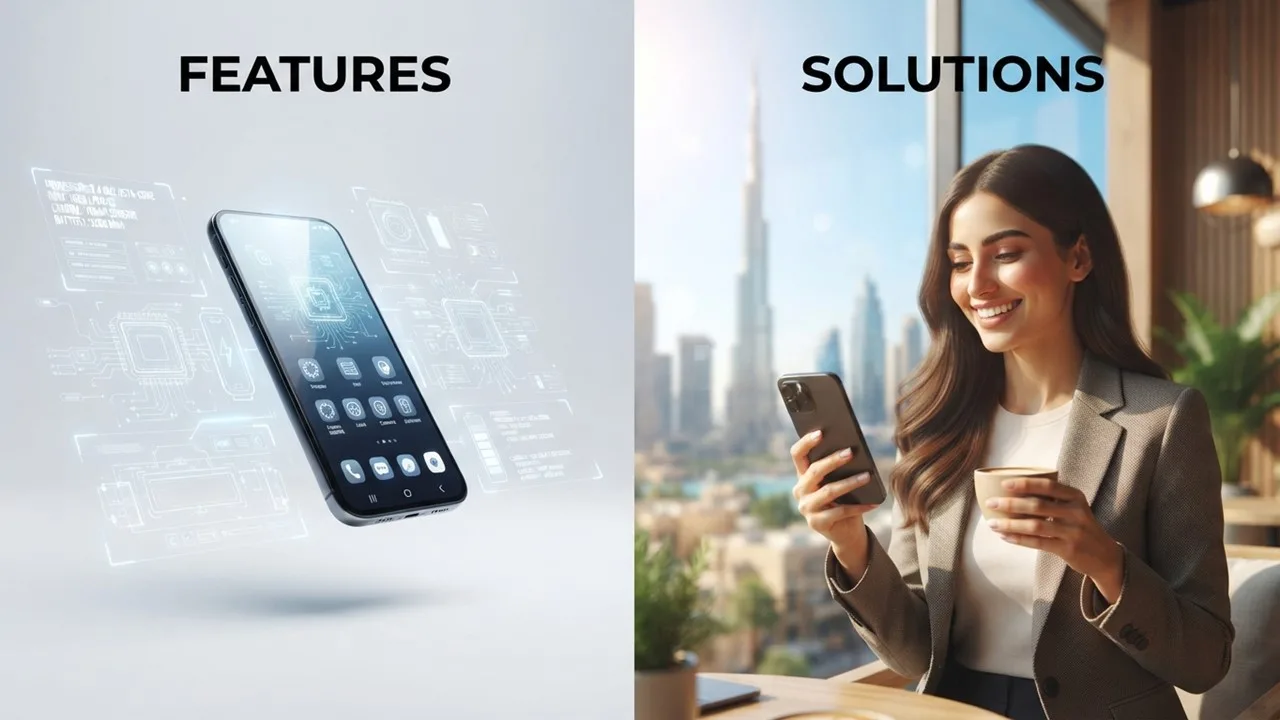
Have you ever walked into an electronics store in Dubai, looked at a smartphone tag, and felt your eyes glaze over? Octa-core processor, 12GB RAM, 256GB storage. This is where the concept of Customers Buy Solutions Not Features comes into play.
Understanding why Customers Buy Solutions Not Features is key to effective marketing. Unless you are a tech engineer, your brain immediately tunes out. Why? Because as humans, we don’t actually care about what a product is. We care about what it does for us.
There is a golden rule in marketing that changes everything: Your features don’t matter. Their problem does. Customers Buy Solutions Not Features. Let’s break down exactly what this means, why it matters so much (especially here in the UAE), and how to use it ethically.
When you consider how Customers Buy Solutions Not Features, it shifts your entire marketing approach.
Features vs. Solutions: What’s the Difference?
Why Customers Buy Solutions Not Features Matters in Marketing
This distinction is crucial as it shows how Customers Buy Solutions Not Features in every decision.
Understanding Why Customers Buy Solutions Not Features
To put it simply, a feature is a tool, a spec, or a physical part of your product. It’s objective. A solution is an outcome, a feeling, or the removal of a headache. It’s personal.
Think of Theodore Levitt’s famous marketing analogy: People don’t want to buy a quarter-inch drill. They want a quarter-inch hole. If a customer could wave a magic wand and get that hole without buying your heavy, noisy drill, they would do it in a heartbeat. The drill is just a necessary evil to get to the solution.
When you pitch features, you force your customer to do the mental gymnastics of figuring out why they should care. When you pitch solutions, you do the heavy lifting for them.
By recognizing this, you can better understand how Customers Buy Solutions Not Features.
Does This Actually Work in the UAE?
Absolutely. In fact, consumers and businesses in the UAE filter out features faster than almost anywhere else because our market is hyper-focused on two massive priorities: time and status.
Take the brutal UAE summer as an example. If a car dealership tells you a vehicle has a 400-watt AC compressor with smart mobile integration, that’s a feature list. But if they say, “You can remote-start your car from your phone so it’s freezing cold the exact moment you step inside,” that is a solution.
We live in a fast-paced environment where convenience is king. People are more than willing to pay a premium for products that hand them back their weekends or eliminate daily friction. Furthermore, with over 200 nationalities living in the Emirates, technical features often get lost in translation. Universal human problems, like wanting more time, less stress, or better health, are understood by everyone.
People inherently know that Customers Buy Solutions Not Features, which is vital for marketers to grasp.
The Evolution: Can a Company Keep the Same Features Forever?
The short answer is no. While a core human problem (the need for a solution) can stay the same for decades, the technology required to fix it (the features) must constantly adapt.
Decades ago, the solution to getting from Dubai to Abu Dhabi comfortably was a rugged 4×4. Today, it’s an electric vehicle or a high-speed rail. The problem never changed, but the tools had to evolve. If a company freezes its features, competitors will swoop in with better technology, and the company will eventually fade away. To survive, businesses must be deeply obsessed with the customer’s problem, but incredibly flexible with their own product features.
Recognizing this evolution is essential because Customers Buy Solutions Not Features.
The Fine Line of Ethical Marketing
Shifting your focus from features to solutions is a powerful marketing strategy, but it comes with a major responsibility. This is where ethical marketing comes into play.
In an ideal world, the solution is the promise, and the features are the proof. Solution marketing is ethical when your product’s technical specifications can genuinely back up your emotional claims. It becomes unethical when there is a “solution gap,” which means selling a beautiful, stress-free dream in the headline, but building the product with cheap, faulty features that cannot deliver on that promise.
Ultimately, when you understand how Customers Buy Solutions Not Features, you empower your marketing strategy.
Stop telling the world how hard you worked on your product’s features. Instead, start showing them how much you understand their daily struggles. When you speak the language of solutions, you stop chasing customers and start solving their problems.